Legal Publications
During his judicial career, attorney Amer Halaseh published a number of specialist works on criminal law, particularly the criminal jurisdiction of the State Security Court, crimes against state security, and terrorism offenses. These works have earned academic and professional recognition as pioneering references in these fields in the Hashemite Kingdom of Jordan, bringing together legal scholarship, case law, theory, and practice. Some have been adopted as course textbooks at Jordanian public and private universities. These publications include:
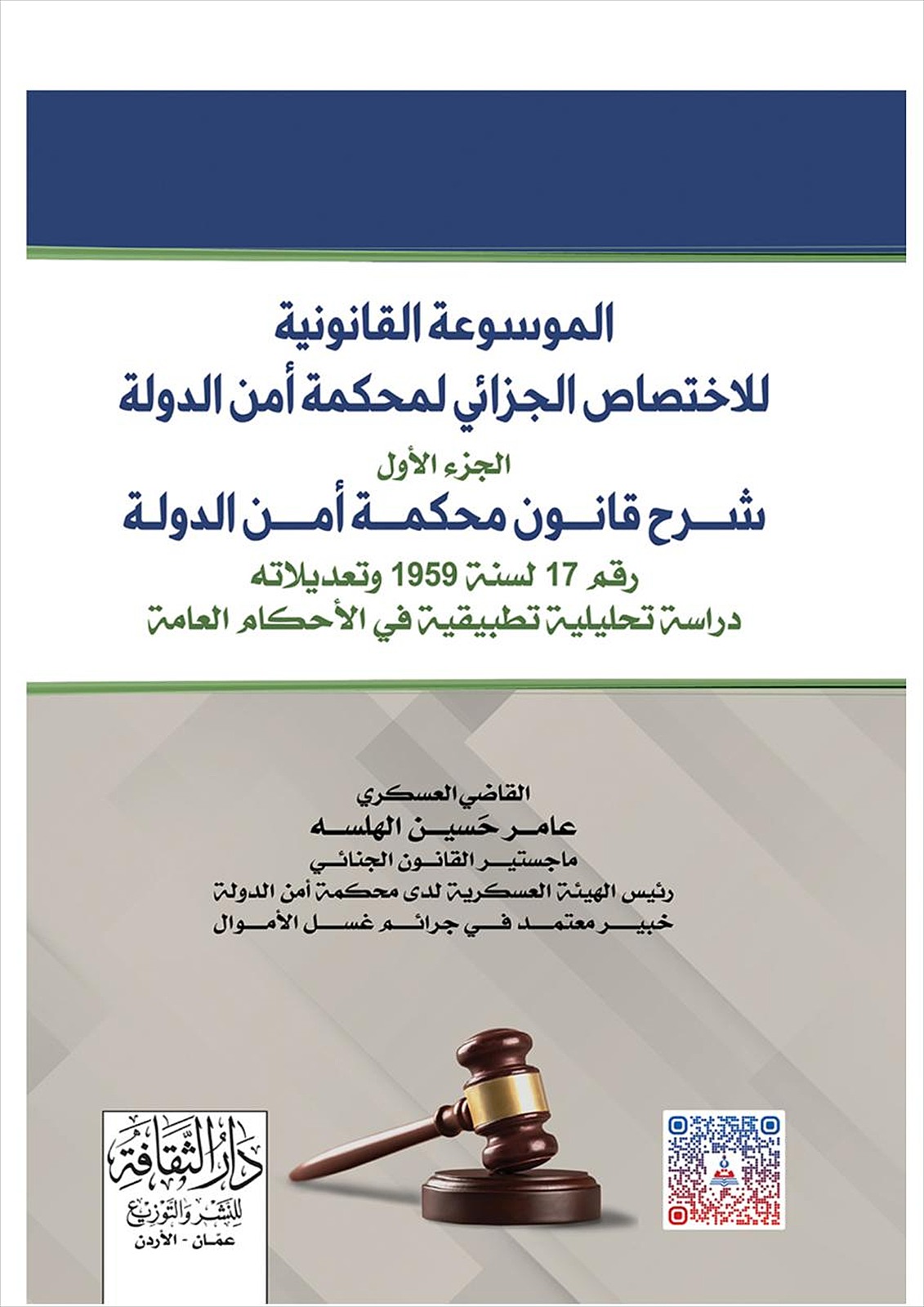
Volume One: Commentary on the State Security Court Law
The first volume of the Legal Encyclopedia of the Criminal Jurisdiction of the State Security Court, authored by Military Judge Amer Halaseh, is among the leading specialist legal publications in the Hashemite Kingdom of Jordan to examine the law governing the State Security Court, a special court with a distinctive character within the Jordanian judicial system.
This work presents an in-depth scholarly and analytical study of the State Security Court Law. It begins with the court's origins and the historical and legislative circumstances that led to its establishment, before examining its constitutionality and legitimacy, the manner in which it is constituted, the limits of its jurisdiction, and the extent to which its legal structure accords with the requirements of the public interest.
The author also analyzes the fundamental safeguards of a fair trial before the State Security Court, both in the composition of the judicial panel and in the procedures governing the conduct of trials, within the framework of constitutional principles and the general rules of criminal justice.
The encyclopedia is of considerable scholarly and practical significance. It serves as an important reference for judges, public prosecutors, attorneys, academics, and postgraduate law students, offering a clear analysis of the statutory provisions governing the State Security Court and explaining the scope of its criminal jurisdiction in light of judicial practice and relevant jurisprudence.
To obtain a copy of this encyclopedia, please contact Amer Halaseh Law Firm through our website.
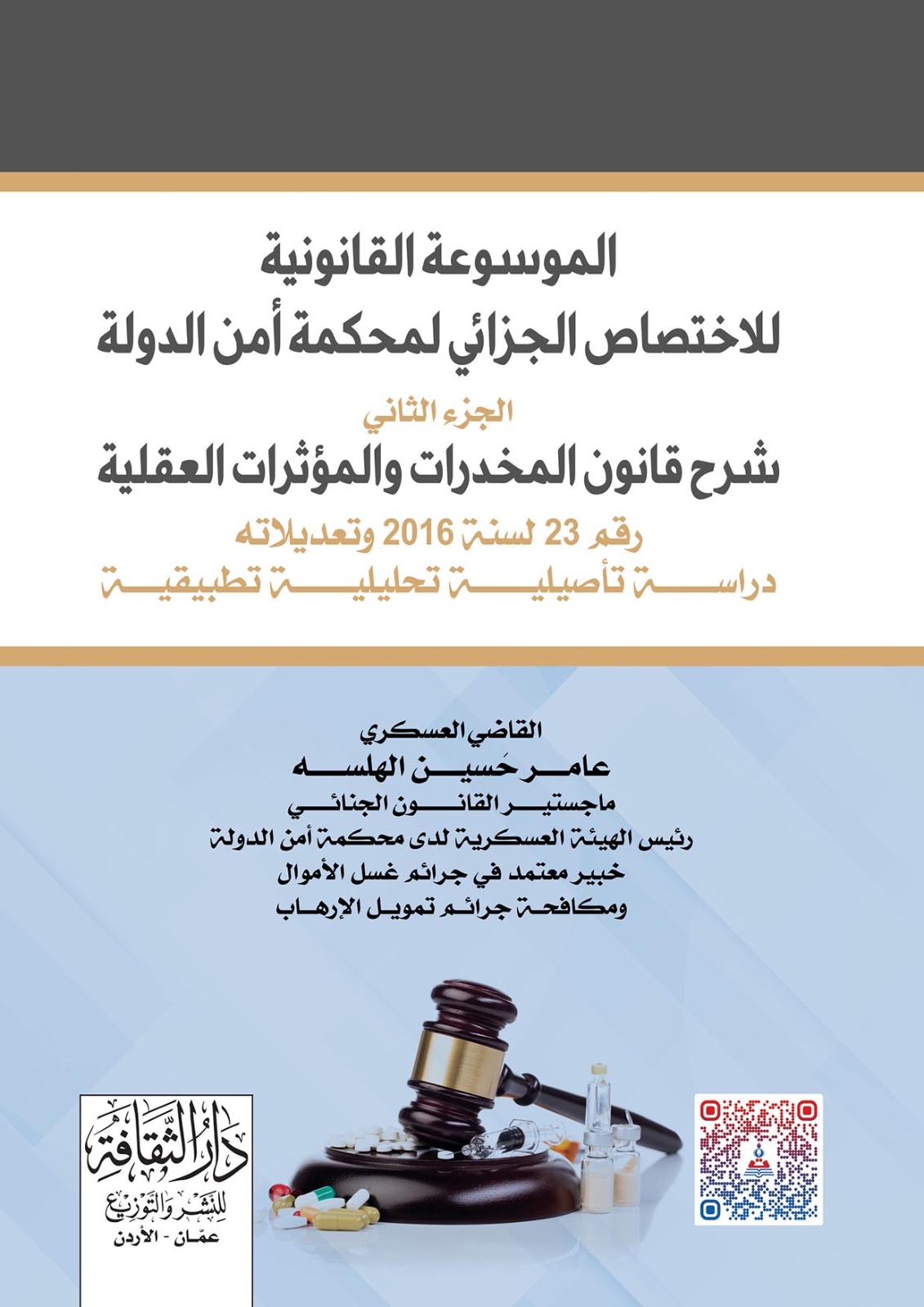
Volume Two: Commentary on the Narcotic Drugs and Psychotropic Substances Law No. 23 of 2016 and Its Amendments
This volume is Military Judge Amer Halaseh's second work in the Legal Encyclopedia of the Criminal Jurisdiction of the State Security Court series. It examines and explains the Narcotic Drugs and Psychotropic Substances Law No. 23 of 2016 and its amendments, setting out the State Security Court's jurisdiction over the offenses prescribed by that law. The legislature has vested exclusive jurisdiction over these offenses in the court, with the statutory basis established in Article 3 of the State Security Court Law.
This volume provides a comprehensive analytical account of the provisions of the Narcotic Drugs and Psychotropic Substances Law. It traces the historical development of drug legislation in the Hashemite Kingdom of Jordan, examines its successive legislative stages and amendments, and explains the fundamental concepts associated with the law. These concepts provide an essential foundation for understanding the statutory provisions and discerning legislative intent.
The book also presents a detailed study of the various offenses prescribed by the Narcotic Drugs and Psychotropic Substances Law, analyzing the constituent elements of each offense. The analysis draws on practical application, the jurisprudence of the State Security Court, and the legal principles established by the Jordanian Court of Cassation in its criminal jurisdiction when considering appeals against judgments of the State Security Court.
The author further addresses the practical aspects of challenging judgments issued by the State Security Court in drug-related cases, explaining the legal grounds on which an appeal in cassation may be brought. The book also examines the suspension of sentences in these cases and the extent to which it is available under the relevant statutory provisions.
The book also devotes attention to the legal rehabilitation of persons convicted of offenses under the Narcotic Drugs and Psychotropic Substances Law after completion of their sentences, recognizing its importance in facilitating their reintegration into society in accordance with the applicable legal requirements.
The work departs from conventional presentations of statutory provisions, adopting an approach that combines theoretical foundations, legal analysis, and judicial application. This approach makes the provisions more accessible to readers and reveals their practical implications. Through this undertaking, the author aims to provide a practical legal reference that facilitates understanding of the Narcotic Drugs and Psychotropic Substances Law and makes a significant contribution to Jordanian criminal law literature, in the hope that it will assist judges, attorneys, and academics.
For advice and representation in drug cases, see Drug Crimes Lawyer in Jordan: Attorney Amer Halaseh.
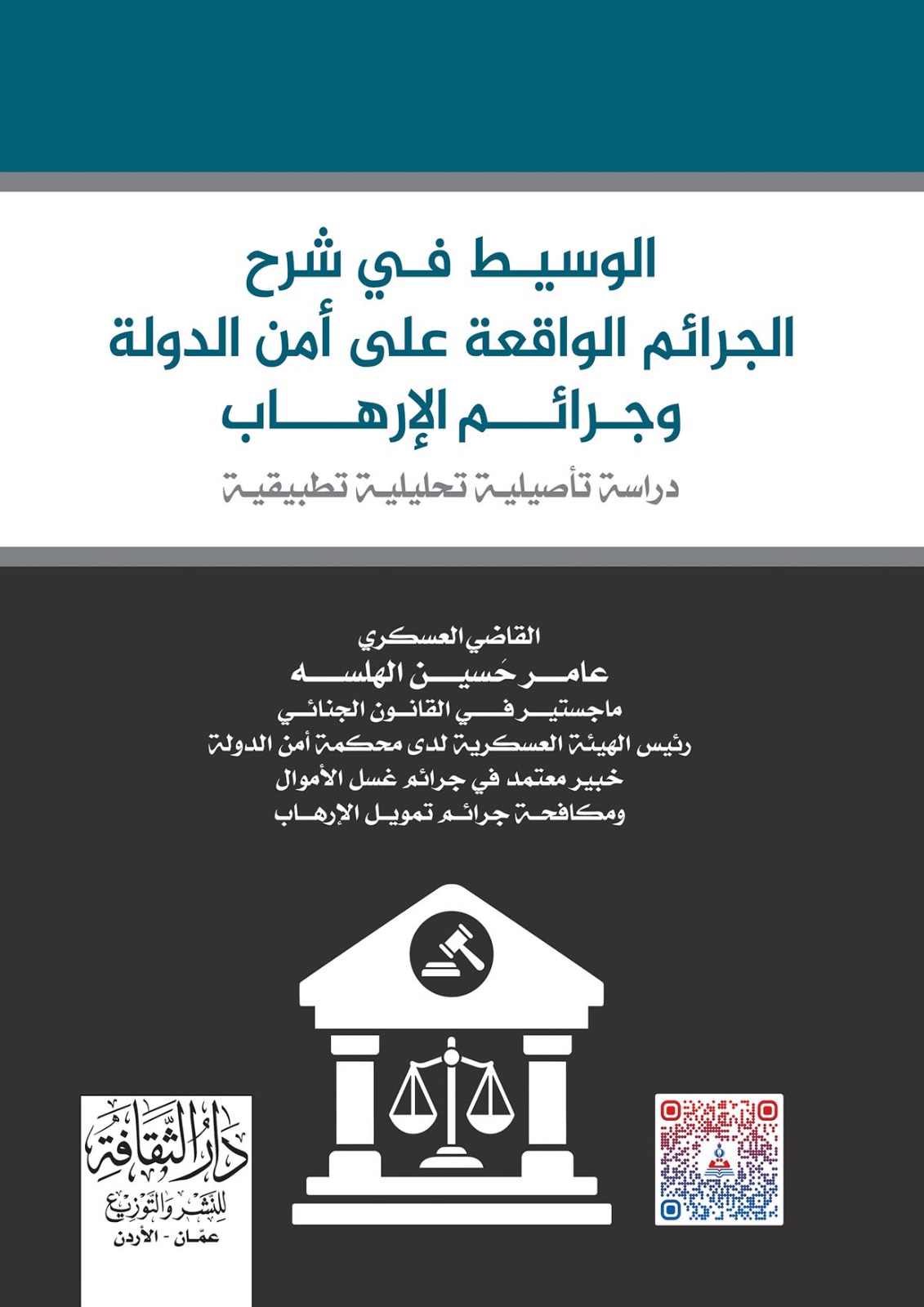
A Treatise on Crimes Against State Security and Terrorism Offenses
A Treatise on Crimes Against State Security and Terrorism Offenses, authored by Military Judge Amer Halaseh, is among the leading specialist legal references in the Hashemite Kingdom of Jordan to explain and analyze this subject. It responds to the academic need within Jordanian universities for a modern scholarly reference addressing crimes against state security and terrorism offenses in light of the latest legislative amendments. It also addresses the practical need of legal professionals to understand the provisions governing these offenses and their application by the courts.
The book examines and analyzes crimes against state security and terrorism offenses, drawing on practical application and the judgments and decisions of the State Security Court and the regular courts. It is also informed by the jurisprudence of the Jordanian Court of Cassation in its criminal jurisdiction and the legal principles it has established over many years of judicial practice.
This scholarly work seeks to enrich Jordanian criminal law literature by combining judicial experience with legal analysis. It provides a comprehensive account of the offenses prescribed by the relevant legislation, bringing together theoretical foundations and practical application, and analyzing the constituent elements of each offense in light of the jurisprudence of the State Security Court and the settled case law of the Court of Cassation.
The work also moves beyond conventional presentations of statutory provisions, adopting an analytical approach that makes them more accessible, explains their practical implications, and clarifies aspects that may be ambiguous. In doing so, it helps judges, attorneys, academics, and law students develop a sound legal understanding of these offenses.
The author hopes that this work will make a significant contribution to Jordanian legal literature and serve as a scholarly and practical reference, assisting researchers and other interested readers in understanding and analyzing crimes against state security and terrorism offenses in light of legislation and judicial precedent.